Case Study

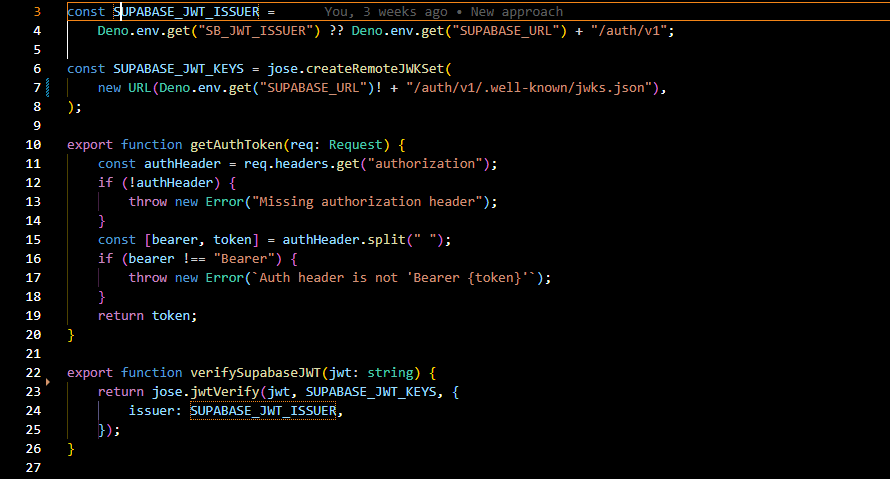
When Supabase rolled out its security upgrade from symmetric (HS256) to asymmetric (RS256) JWT keys, I ended up losing almost an entire workday to debugging and detective work instead of building features. Of course, these things happen every once in a while, and are not the end of the world. Yet, it is still frustrating.
Starting out with a "small" error
It started with what looked like a minor, isolated error in a single Edge Function. There was no clear warning that a fundamental part of the auth model had changed, just a cryptic JWSError: JWSInvalidSignature that didn’t obviously point back to a key migration or token signing change.
So I did what most developers do:
Double‑checked my own code, assuming I had misconfigured something.
Went through changelogs and release notes, trying to connect a vague runtime error to a specific change, but there were many changes and no single, obvious "this is why your app broke" entry.
Tried to mentally replay “what changed since this last worked” while users still depended on the app being stable.
Because the issue appeared first in just one function, it felt like a local bug rather than a broader platform shift. That made it harder to see the real cause early.
Finding the root cause (and more questions arise)
After doing some research, I eventually found a blog post by Sinan Csoysal describing almost exactly what I was seeing: Self‑hosted Supabase Edge Functions failing with JWSInvalidSignature after changes to how JWTs are signed and verified. That article connected the dots between "random auth error" and "platform‑level security upgrade."
Even with this guide, fixing the first obvious issue didn’t make everything green. Instead I got a series of cascading issues:
Environment variables and secrets had to be re‑audited across multiple services.
Local development behaved differently from production, especially in a self‑hosted setup.
New, smaller issues surfaced in specific code paths, which made everything feel like a series of edge cases instead of one clear migration task.
None of these problems felt "big enough" on their own to justify opening a formal issue or writing a long forum post, but for me, they together blocked a full day of progress.
Why existing support channels often fall short
In situations like this, the usual support options don’t quite match the kind of help you actually need:
Opening an issue feels too heavy, as one is often thinking, "I’m probably just missing one configuration detail."
Posting in community channels is great for knowledge sharing, but you can’t rely on a fast response when your app is already affected.
Documentation and blog posts are improving all the time, but during active transitions there’s often a gap between what’s written down and what happens in a real project.
What I really needed in that moment was not more docs, but a short, focused conversation with someone who had already gone through this migration and could look at my specific configuration, environment, and code.
Where Githelp fits into this story
This experience is a good illustration of the problem Githelp is built to solve.
There are plenty of times where you don’t need a long‑term consultant or a big integration project. You just need:
A developer who already understands the latest changes in a particular stack (in this case, Supabase’s new JWT signing model).
A quick way to share context (logs, config, code snippets) without over‑explaining.
A time‑boxed, compensated session where the goal is simple, such as: get you unblocked and safely through the migration.
Instead of:
Spending hours searching for the right blog post or GitHub comment.
Hesitating to bother maintainers or the community with what might be a small misconfiguration.
Hoping that an answer shows up before you have to make a hard trade‑off on timelines.
With a dedicated support setup like Githelp, you can turn an unpredictable, frustrating debug session into a controlled, predictable interaction: you reach out, get matched with someone who knows the territory, ideally on the project core team, and move through the migration together.
For us, that Supabase upgrade was a clear reminder: Even when a platform makes the right call on security, the path from shipping the change to have it work in your production environment is rarely straightforward. Githelp exists to bridge exactly these kinds of gaps.
A quick disclaimer: Of course this situation is not unique to Supabase and is a common occurence with any framework when developing. If you are not familiar with Supabase, it is something we use ourselves and highly recommend as a great Open Source alternative for hosting your backend yourself or on their servers. Feel free to check them out here: https://supabase.com (not sponsored)
Share Article